


By Ryan Tribbett | Government Affairs Specialist, Mid-Valley Association of REALTORS®
Something unusual is happening in Salem’s real estate economy.
Homes are sitting longer. Sellers feel forced to reduce their asking prices, yet homes still remain out of reach for many prospective buyers. Builders are increasingly constructing rental housing rather than homes for purchase. Commercial properties are changing hands, and investors are spending millions to bring aging downtown buildings back to life. Yet several prominent commercial spaces remain underutilized in the long term, and some redevelopment projects are struggling to get off the ground.
So, is Salem’s economy struggling? Or are the ways residents and businesses participate in that economy fundamentally changing?
Those questions were front and center at AmeriTitle’s Oct. 14 “State of Real Estate: Industry Insights & Outlook” conference, where more than 200 real estate professionals examined trends shaping the Mid-Willamette Valley.
Buyers and Sellers Remain Locked in a Standoff
“Today’s rates are historically ordinary, but today’s prices are historically extraordinary,” said Eric Templeton, AmeriTitle Senior Vice President.
Templeton’s research illustrates a housing market struggling to find its balance. Sellers are increasingly reducing asking prices, yet the broader correction he believes is necessary hasn’t materialized.
The problem? Homeowners holding mortgages at 4% or less have little incentive to sell, limiting inventory and helping keep prices elevated even as buyers struggle to afford what’s available, he said.
Neither side is particularly happy, and waiting for the other to blink has become something of a strategy. But builders, unlike existing homeowners, can’t simply wait indefinitely.
Builders Are Cutting Prices, but Buyers Still Can’t Afford the Payments
Mike Erdmann, CEO of the Home Builders Association of Marion & Polk Counties, reported that more than one-third of new homes sold in 2026 underwent advertised price reductions — the highest share since 2012.

From January-September 2026, 36.5% of new-home sales involved a list-price reduction, while 23.4% closed at least 3% below their original asking price. Source: Home Builders Association of Marion & Polk Counties / WVMLS.
Yet reducing the asking price doesn’t necessarily solve the affordability problem. What matters to most buyers is what they can afford each month.
Erdmann’s calculations suggest mortgage payments on an average newly constructed home would consume approximately 45% of the median family’s household income, approaching levels experienced before the 2008 housing crash.

Mortgage principal and interest on an average newly constructed home would consume approximately 45% of Marion County’s median household income, assuming a 10% down payment and a 30-year fixed mortgage. The calculation excludes property taxes and insurance and uses estimated household income for 2025 and 2026. Sources: WVMLS, HBA New Construction Statistics, Freddie Mac and Census SAIPE.
And the consequences extend beyond individual homebuyers. Developers are increasingly building housing intended for renters.
That’s an important part of meeting Salem’s housing needs, but it also illustrates why adding housing units and expanding homeownership opportunities are two different measures of progress.

Apartments accounted for 60% of Salem’s newly permitted housing units during the 12 months ending September 2026. Including middle housing built primarily for rent, Erdmann estimates that more than 70% of new housing production is rental-oriented. Source: City of Salem permit reports / Home Builders Association of Marion & Polk Counties.
Commercial Investment Tells a Different Economic Story
If residential housing were the only measure, one might conclude Salem’s economy was simply losing momentum. But that’s not the whole picture.
Nick Williams, CCIM, Vice President of Capacity Commercial Group, presented research showing Salem ranks ninth among the nation’s 50 state capitals for growth in employment supported by dollars being invested into the local economy.
Those jobs, particularly in healthcare, manufacturing and distribution, create the foundation for housing demand, restaurants, retailers and other local businesses.
Williams also documented approximately $368 million in commercial property sales across Marion and Polk counties, with multi-family properties accounting for the largest share.

Salem ranks ninth among the nation’s 50 state capitals for growth in basic employment from 2015 to 2025, while ranking 28th for retail job concentration. The comparison illustrates how industries that bring outside dollars into the community help support the local businesses and services residents rely on. Source: Capacity Commercial Group analysis of U.S. Bureau of Labor Statistics employment data, October 2026.
Clearly, investors continue to see opportunities in the region. The more complicated question is what happens after that investment arrives.
Downtown Developers Are Finding That Yesterday’s Economics No Longer Work
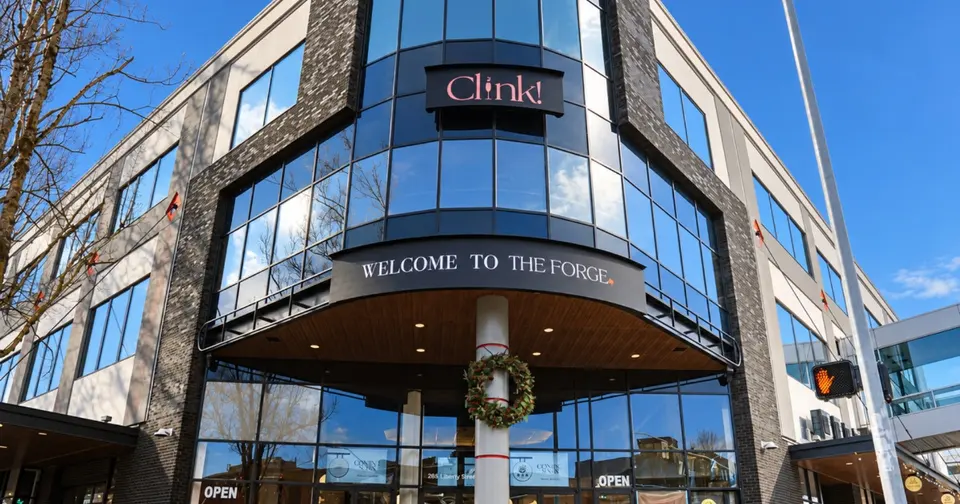
A.J. Nash, Partner and Principal Broker at Tradition Real Estate Partners, helped transform the former Liberty Plaza building into The Forge, a roughly $12 million redevelopment now reporting 92% occupancy. Getting there required more than finding tenants. Permitting requirements designed for another era added considerable costs and complexity, while owners invested in improvements and redesigned spaces around what local businesses could realistically afford.
Charles Weathers of ORREO Development demonstrated the other side of the equation. His redevelopment of the historic Grey Belle building into Fork Forty, a modern food hall bringing independent restaurants together under one roof, illustrates how thoughtfully aligned historic preservation tax credits and public incentives can help make ambitious projects financially viable.

Historic redevelopment projects demonstrate how aging downtown properties have been transformed into modern commercial and residential spaces. Photographs courtesy of ORREO Development.
The existence of investment capital doesn’t guarantee development will happen. Somebody still has to make the numbers work based on what the property can realistically earn from its intended use. That’s the challenge facing policymakers, regulatory agencies, and commercial developers alike: finding the right alignment between development costs, regulatory requirements, financial incentives, and economic viability.
And frankly, getting all that right is an art form.
Salem’s Next Challenge Goes Beyond Simply Generating Growth
T.J. Sullivan of Salem Main Street Association offered a reminder that revitalization also requires people showing up, supporting local businesses and participating in the communities being rebuilt.
Taken together, the presentations suggest Salem’s challenge isn’t simply a lack of economic activity.